3. Flow Simulation and Validation Results
The equations governing the particle are solved using the 2nd order Rang-Kutta method. All the forces acting on the particle are calculated and finally applied in the form of C++ code and verified. Errors were very low.
In order to investigate the effect of the initial velocity of the drop on its movement, two velocities higher than the reference state and two velocities lower than the reference (15 m/s) with a step of 2.5 m/s have been used. As the speed increases, the heat transfer coefficient increases, and it is expected that with the increase in the heat transfer rate, the rate of evaporated mass from the droplet surface will also increase, and the droplet will need less time to evaporate.
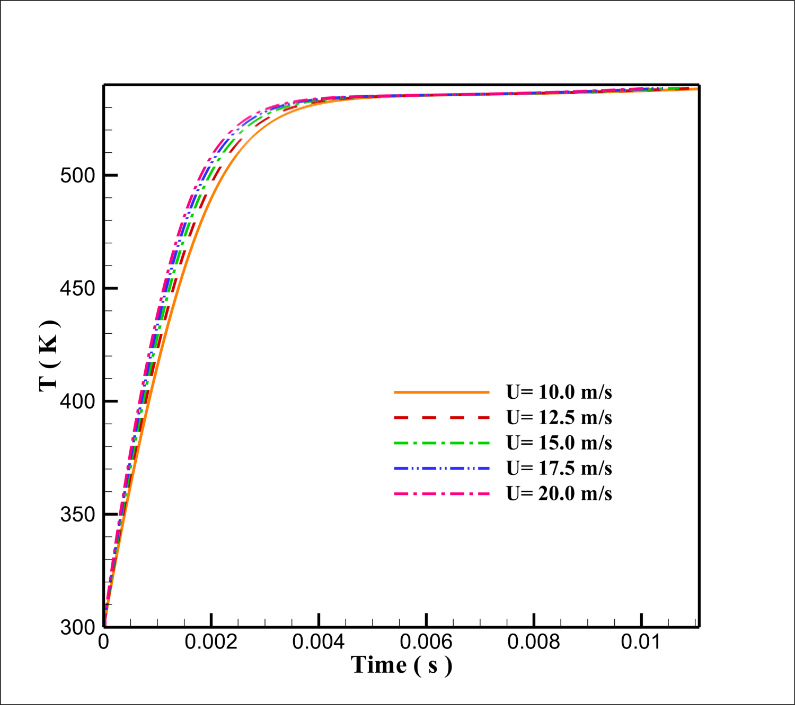
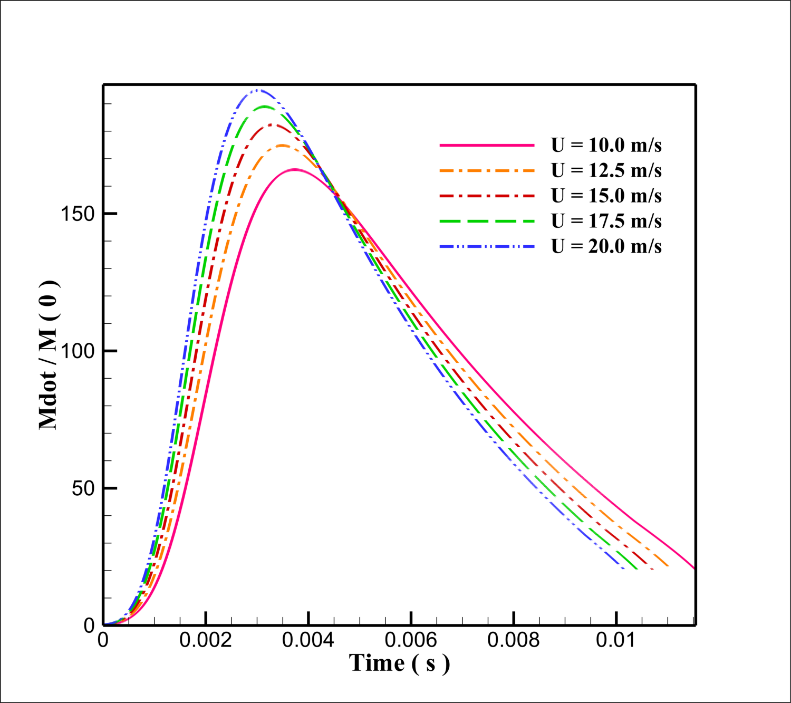
In summary, the results are as follows:
- With the increase in the diameter of the droplets, the maximum level of evaporation is increased. For this reason, in applications related to combustion and especially cooling, air liquid should be injected in the form of sprays and drops so that it has the maximum level for evaporation. With the increase in the droplet diameter, although the evaporation increases, the shelf life of the droplet is prolonged. Therefore, in the spray, one should seek to create many droplets with small size so that the maximum level of evaporation increases and the evaporation time decreases.
- With the increase of time and moment, the drag force decreases because with the increase of time, the diameter of the drop and also its speed decrease, which should also decrease with the decrease of these two factors, and so on.